Update: This proposal is now up for voting in the Giveth Snapshot.
The vote aims to ratify the move to a monthly GIVbacks cadence as well as clarify one of the parameters where the results of the poll was a tie (Maximum Prize Amount).
The other two parameters had less contention and will be implemented as follows if the vote passes:
- Maximum Monthly Prize Pool Amount - 1.5M GIV
- Number of Winners Drawn Each Month - 15
Hello Givethers,
The GIVbacks team has been reviewing how the raffle has evolved over the past year and how we can make the experience smoother, more exciting, and more sustainable. After internal discussion within the team, we are bringing this proposal to the community as part of the formal advice process.
The goal is to shift the GIVbacks raffle from a biweekly cycle to a monthly one. The change looks simple on the surface, but it carries a few real benefits for Giveth, donors, project owners, and the team that operates the system. This thread opens the floor to feedback, ideas, and questions.
Current GIVbacks Structure
For clarity, here is how GIVbacks currently works:
• Frequency: Biweekly rounds
• Prize pool: 1,000,000 GIV p/round (maximum)
• Winners: 10 per round
• Top prize: 50% of the prize pool (max 500,000 GIV)
These parameters were set when the raffle system launched (refer to the announcement blog post for each prize’s size %). To maintain consistency with the original GIVbacks program, the max rewards given out every 2 weeks remained the same (1M GIV), and so did the cadence of GIVbacks round (every 2 weeks).
Since then, the engagement with the program has shifted, with listener turnout on our biweekly X spaces declining over time. This has prompted us to shift our execution and marketing strategy to follow a new cadence:
Proposed change: monthly raffle
We propose moving to one raffle per month, beginning in January 2026 if approved. Everything else is subject to community input.
Key items to decide together:
• Size of the monthly prize pool
• Size of the top prize
• Total number of monthly winners
Our goal is to keep the annual distribution aligned with the GIVeconomy plan (i.e. continuing the program at least until December 2026 with a max 1M GIV available to reward donors every 2 weeks) while making the experience more fun and manageable.
Why consider a monthly GIVbacks raffle?
Moving from a bi-weekly cadence to a monthly one gives us more breathing room, more time for outreach, and more space to make each round feel like an event.
Key benefits:
• Less operational overhead for the execution team. A monthly cadence cuts the internal workload roughly in half. No major technical changes are required, only a few small tweaks would be needed.
• More time to hype each round. We can build momentum around a monthly X Space to replace the bi-weekly one. With a larger pool of winners and a larger prize pool, it’s easier to build hype around the event and engage more participants.
• A prize structure that feels meaningful. If we move to a monthly cycle, the prize pool and number of winners will increase. Instead of two small rounds, we build one larger round that feels more exciting and easier to communicate.
Learnings and context
Before asking the community to weigh in on new parameters, we ran a small experiment.
We looked back at five recent GIVbacks rounds (95-99) and focused on the top 5 winners in each round to see what happened after rewards landed. The idea was simple: build some shared context around how larger rewards are currently being used, without turning the data into a rulebook.
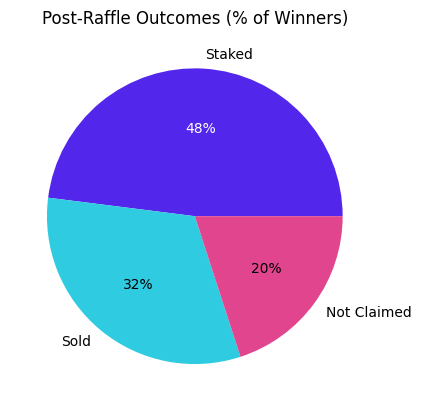
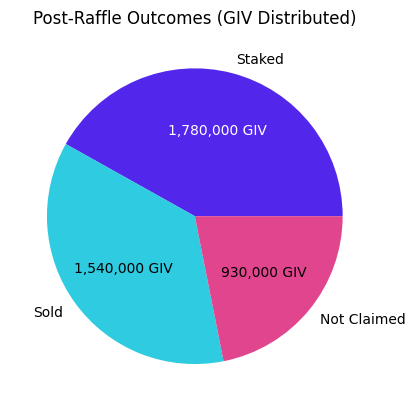
Across these five rounds, we observed a range of outcomes after rewards were distributed. Many winners chose to stake their GIV, while others sold or did not claim their rewards at all.
When viewed by total GIV amount, selling accounts for a larger share than it does by winner count. This indicates that higher-value rewards can carry more weight in shaping aggregate outcomes, even when fewer participants sell.
These patterns suggest that cadence, distribution structure, and follow-up may matter as much as prize size itself. The data is shared here as context to help inform discussion, not as a directive for how to vote.
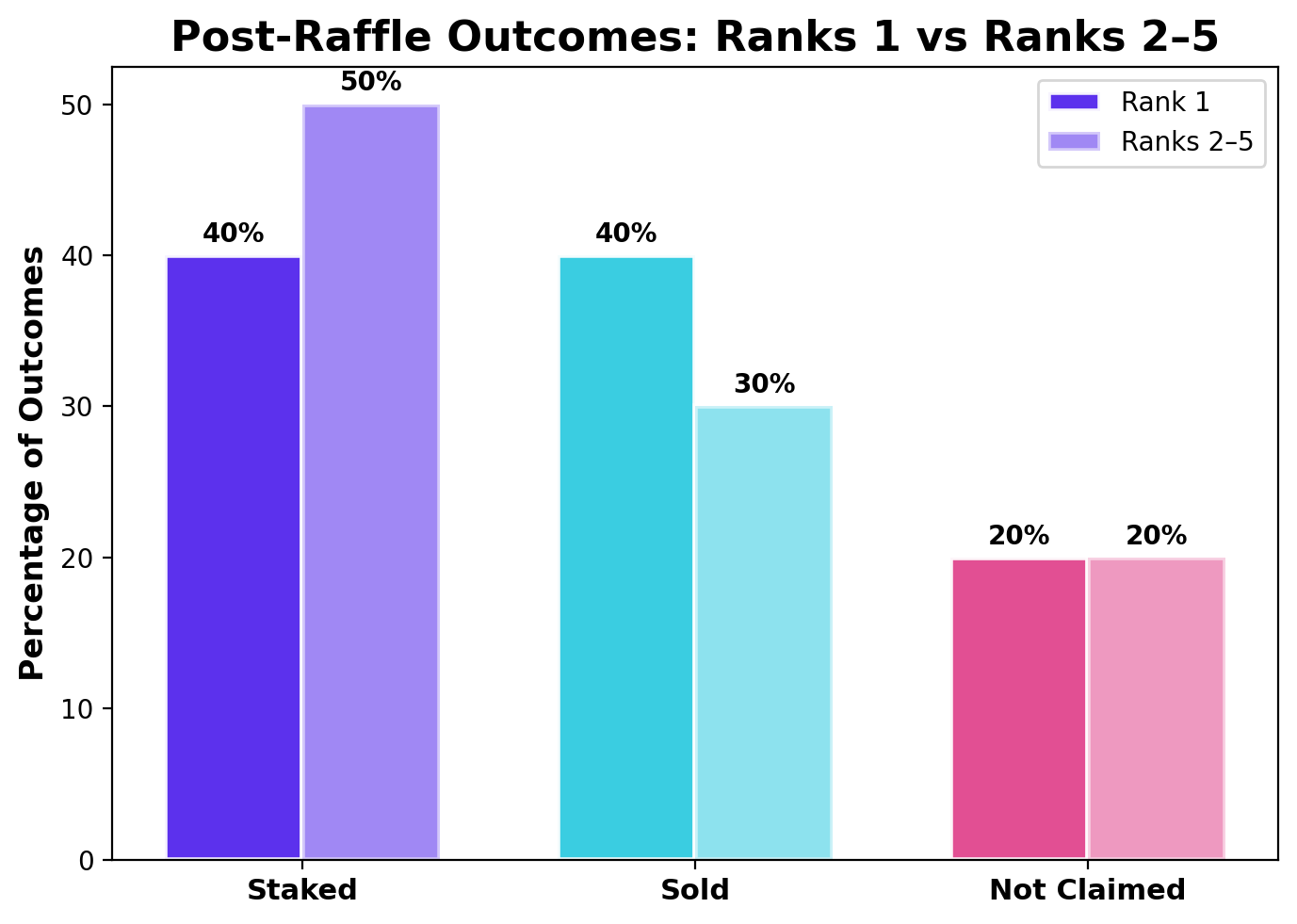
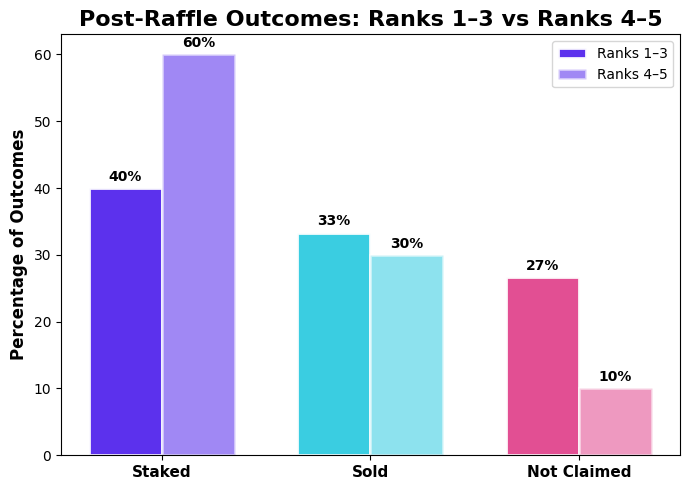
When comparing post-raffle behavior by winner rank (prize tier), a difference emerges. First place outcomes are more polarized, with staking and selling occurring at similar rates. Taken together, these charts suggest that larger prizes introduce more variability in post-win behavior, while smaller prizes correlate with steadier participation with a higher tendency to stake and a lower tendency to sell..Heres the data 
1st place winners (50% of prize pool max 500k GIV):
40% staked, 40% sold, 20% not claimed.
2nd place winners (15% of prize pool max 150k GIV):
40% staked, 40% sold, 20% not claimed.
3rd place winners (12% of prize pool max 120k GIV):
40% staked, 20% sold, 40% not claimed.
4th place winners (4% of prize pool max 40k GIV):
60% staked, 40% sold, 0% not claimed.
5th place winners (4% of prize pool max 40k GIV):
60% staked, 20% sold, 20% not claimed.
Narrative gravity vs systemic resilience
Large top prizes generate strong narrative gravity. They bend attention, create clearer headlines, and give the community a big moment to rally around. This gravitational pull is one of the reasons GIVbacks works as a storytelling and marketing engine.
At the same time, spreading rewards across more winners strengthens systemic resilience. Engagement is distributed, participation stabilizes, and more donors remain active in the ecosystem over time.
Neither force is good or bad on its own. The purpose of this proposal is to tune how much narrative gravity and how much resilience we want to generate in each monthly cycle.
The polls:
1. Monthly prize pool size
With a monthly format, a prize pool of 2,000,000 GIV seems like a natural starting point, since it mirrors the current annual total and wouldn’t introduce a new systemic risk.
(12 months * 2M = 24M GIV, slightly below the current 26M).
We want to get a temperature check on this and ensure that the community sentiment is aligned with our instincts.
Extra context: More than 2M would mean allocating more GIV to GIVbacks than the initial allocation at the launch of the GIVeconomy. So far, the GIVbacks program has distributed 63.3M from the 130M that was initially allocated.
What should the maximum monthly prize pool be set at?
- 2M - keeps alignment with initial allocation, is an exciting number for marketing and ensures strong prizes
- 1.5M - saves GIV tokens and affords us the potential to extend the GIVbacks program in the future
- Other - comment below
2. Maximum prize amount
The size of the top prize plays a considerable role in shaping how each monthly round feels and behaves.
Recent data shows a mix of outcomes across prize sizes and ranks. Rather than pointing to a single “correct” number, it highlights a design choice about how much narrative gravity we want to concentrate into one outcome versus how much we want to distribute across the system each month.
What should the maximum prize be for the number 1 winner?
- 1M GIV - Creates a strong headline prize for the monthly round, amplifies visibility and hype, and concentrates more narrative energy into a single moment.
- 500K GIV - Aligns with the current biweekly top prize. Keeps the distribution flatter and emphasizes systemic resilience.
- Other - comment below
3. Number of monthly winners
Winner count determines how concentrated or spread out each monthly round is. Fewer winners mean larger individual prizes and more focused attention. More winners spread participation wider, with smaller rewards per person.
Because the monthly prize pool is fixed, this choice directly shapes both the experience of winning, how many people are pulled into each round’s momentum, and how many voices and perspectives can show up in the monthly X Space conversation.
How many winners should be chosen in each monthly round?
- 20 winners - larger events/network effect
- 15 winners - middle ground
- 10 Winners - bigger prizes
Next steps
This post will be open for at least five days as part of the formal advice process. After gathering feedback and finalizing the options, we will prepare a Snapshot vote with the parameters that reflect community consensus through the polls and comments.
If approved, the new monthly GIVbacks raffle format will begin in January 2026 with the first X space after the end of the round.
Thank you for taking the time to read and share your thoughts. The more input we receive, the better we can shape a GIVbacks system that is exciting for donors, rewarding for active community members, and sustainable for the team.
 We are excited to implement the new cadence.